

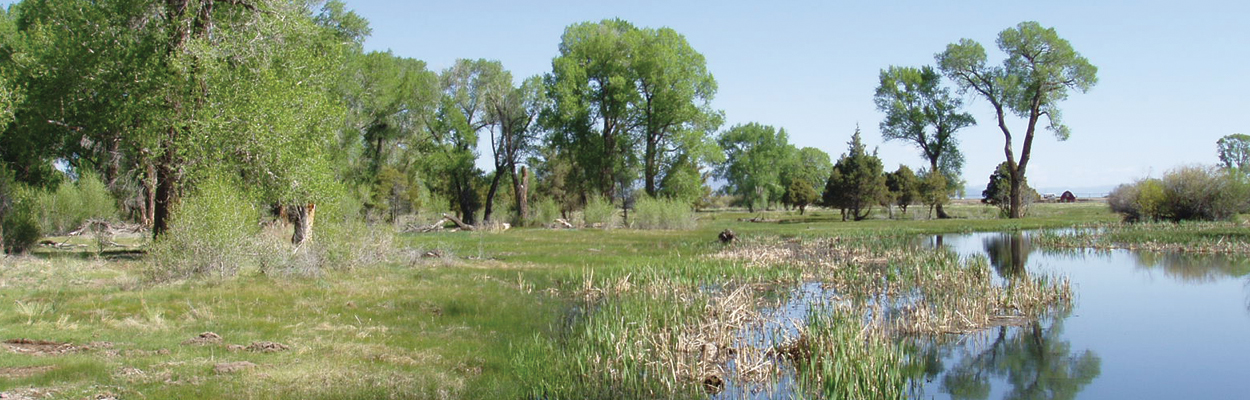


Wherever water runs in an arid world, it leaves a mark. If a ditch leaks, even for a short time, onto a fallow corner there will be a narrow streak of green weeds recording on the ground the extent of its travels. If it continues to run there, grasses may start to show up, and in time some sites will support willows, trees or even cattails. Where water fails to run is also recorded on the land. If I fail to wet a spot of soil when irrigating a new crop of barley, that spot will remain brown and barren until July’s rain brings on a weak and tardy stand. In a new stand of alfalfa that spot will eventually be marked as a thin weedy patch in the field. Forests, meadows, wetlands, fields and deserts stand as testimony to the historical contact with water.
Just as the touch of water leaves a print on the landscape, it also shapes the communities (natural and human) surrounding that landscape. Some species, like willows and beavers, will colonize only areas very near dependable water. Others, like horned lizards and prickly pear cactus, are found where water seldom flows. Deer, elk and water fowl arrange their territories and seasonal movements around dependable water and the vegetation and cover it supports. Cities have traditionally flourished only where adequate flowing water exists. Even with today’s technology to pump and pipe water, the growth of many Colorado cities is still constrained by water supplies.
Economies also grow and contract and change based on the availability and use of water in the community. When water is transferred from Lamar to Aurora, the economic activity associated with that water use is also transferred. The nature of the activity changes as well. Water and money that once supported alfalfa production, tractor dealerships and truck drivers in the Arkansas Valley now support development, hospitals and teachers in the Denver metro area.
While the Colorado economy as a whole is very adaptable and might grow in aggregate from such transfers, individual communities, families and ecosystems are much less flexible. When water is transferred money is also exchanged. But money alone will not replace the activity generated by the use of the water; if it could, the money would have stayed in the urban areas of the state. In the arid West, the availability and use of water is a primary driver and constraint of local economies. Once water has left a community, it cannot be simply replaced by money.
Likewise, a desert ecosystem once transformed by water does not readily revert to a stable productive desert. Some of the least attractive drylands in Colorado are formerly irrigated lands, now barren.
These factors highlight the wisdom and importance of the prior appropriation system of water allocation. We recognize that by applying water to the land we are changing, perhaps forever, the functioning of that land, the landscape that evolves, the lives of the people on that land through generations and the nature of the communities embedded in the resulting landscape.
When a pioneer family diverted water for the first time in an undeveloped area, it represented a huge investment. The wealth and efforts of the whole family was put at risk. A commitment was made to the dry land that the water would come year after year. Communities were built on the foundation of these investments and commitments as teachers, merchants and bankers soon followed.
The prior appropriation system was the legal system that made such commitments possible. It was a form of contract between Colorado and the families and land that formed the nucleus of our towns and cities. The law honored the risk and commitment of all water users by protecting them and their land from those who would come after and forced them to honor the rights of those who came before. As cities grew and absorbed surrounding farms they acquired the water rights with the land. That water, often quite senior, has become an important and stable part of the cities’ municipal supply.
Our system of water laws is the framework within which we have collectively transformed our state. Colorado was once a dry, sparsely populated territory with enormous water resources flowing in narrow ribbons to downstream states. The early Coloradans recognized the transformative nature of water on the land and economy. The prior appropriation system of water allocation was a response to the value of that transformation, the costs involved in its development, and the need for stability and predictability to maintain that transformation. A transformation begun but not finished is merely a disruption- with negative consequences for both economies and ecosystems.
Just as the touch of water has left an indelible print on the land and people of Colorado, so has the wisdom of our water allocation system shaped the State that we all call home.